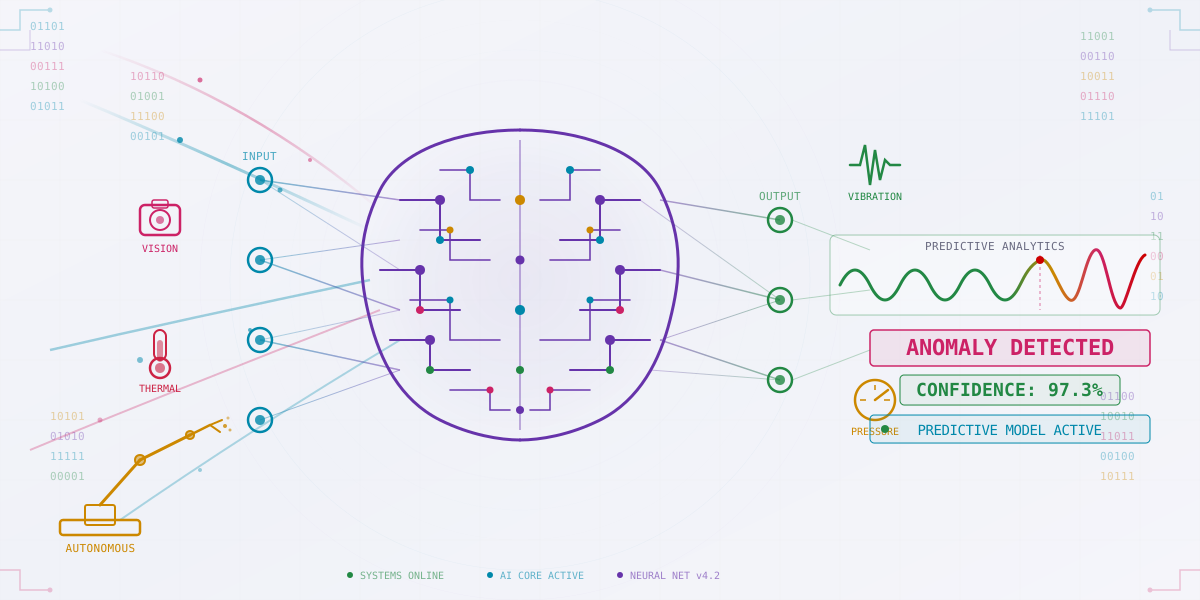
Intelligent Operations — Engineered from First Principles
Digital Twins That Understand the Physics — And Agents That Act on It
Most predictive maintenance solutions are fitted to a data snapshot. They work for months, then degrade as operating conditions shift — because they never understood the physics in the first place. Most "digital twins" are dashboards with a 3D model bolted on. They show you what's happening but can't explain why or predict what will happen under novel conditions.
We build digital twins grounded in first-principles physics — multi-level models spanning components to entire facilities — augmented with operational data and accessible through intelligent agents that reason about the system. Combined with computer vision for monitoring, autonomous systems for action, and explainable AI throughout, this is what intelligent operations actually looks like.
What We Help Solve
Operations and technology leaders across industries face the same Tier 1 challenges:
Predictive Models That Degrade Over Time
Custom-built solutions fitted to data snapshots lose predictive power as conditions shift — without physics grounding, every model becomes a liability within months
Brownfield Assets with Decades of Siloed Data
Multi-era equipment, fragmented databases, no unified operational model — building a comprehensive digital twin requires mapping systems that were never designed to talk to each other
AI Predictions Operators Won't Trust
Black-box analytics that can't explain their reasoning — experienced operators ignore predictions they can't interrogate, and they're right to
The Gap Between Dashboards and Intelligence
Sensors deployed, platforms purchased, dashboards built — but operations haven't fundamentally changed because the underlying models aren't connected to the physics of your processes
Urban Systems Modeled Statistically, Not Physically
Traffic, energy, logistics — city-scale operations modeled by fitting historical data, not understanding the economics and physics that drive them
OUR CAPABILITIES
First-principles intelligence for industrial and urban operations — from component-level physics to facility-wide autonomy.
Multi-level computational models grounded in physics — because your operations are governed by thermodynamics and mechanics, not statistics.
Component → equipment → line → unit → facility modeling with first-principles physics
Data augmentation for parameter calibration — not data replacement for physics
Intelligent agents for querying, reasoning, and operational decision support
Models that maintain accuracy over time because they're grounded in physics, not data snapshots
Automated visual intelligence for industrial operations, construction sites, ports, and urban environments.
Quality monitoring and defect detection on production lines
PPE compliance and workforce safety monitoring
Oil spill detection, monitoring, and estimation
Smart port systems: vessel tracking, container handling, yard optimization
Construction progress tracking and site condition verification
AI that shows its work — built on mathematical foundations that make explainability a design property, not an afterthought.
Physics-informed models that operators can interrogate and trust
Multigrid learning and neural ODE frameworks for mathematical transparency
Human-readable explanations for every prediction and recommendation
Decision audit trails for regulatory compliance and incident investigation
Turning decades of siloed data into a unified, queryable operational picture.
Legacy database mapping and entity/relation reconciliation
LLM-accelerated pattern recognition with recursive validation
Unified data repositories from heterogeneous sources (SCADA, historians, ERP)
Intelligent agents with access to integrated operational data and physics models
Simulation, control, and intelligence for systems that must act — not just observe.
Autonomous navigation and control system development (ROS, Gazebo)
First-principles city modeling for traffic flow simulation and urban mobility planning
Procurement and workflow automation with human-in-the-loop for ambiguity resolution
Pathway to autonomous industrial operations
Ready for Operations Built on Physics, Not Guesswork?
From digital twins to autonomous systems — we build intelligent operations that explain their reasoning and earn operator trust.