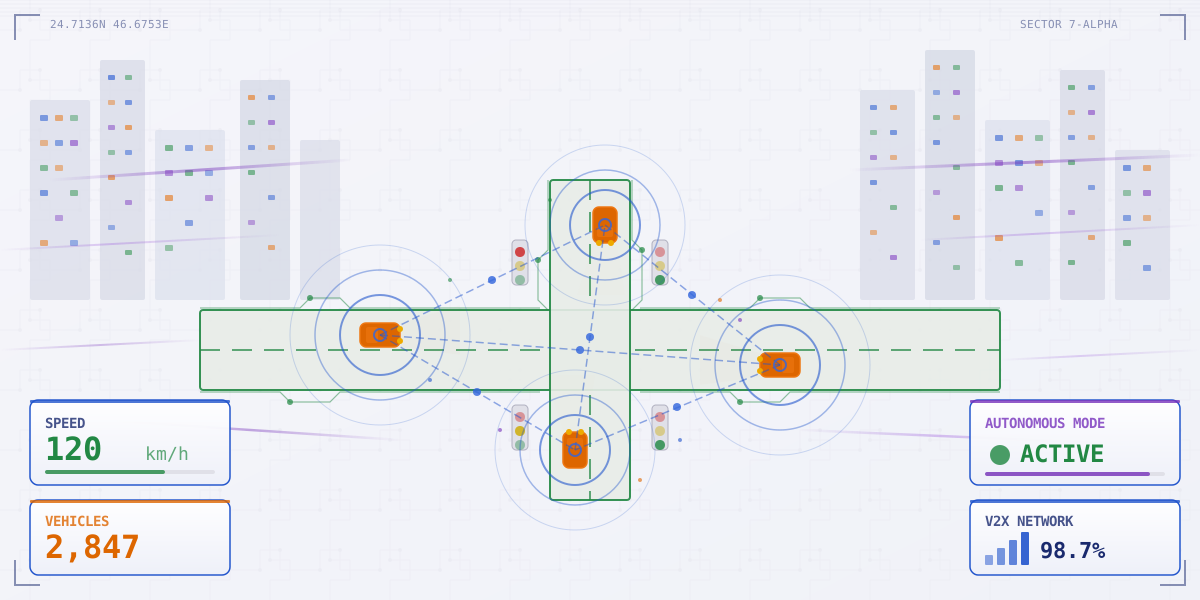
Engineering What Moves — From Simulation to Autonomy
Simulation, Control, and Intelligence for Everything That Moves
Mobility systems — whether a vehicle on a highway, a vessel in a port, or traffic across a city — are governed by physics that must be modeled accurately before autonomy can be trusted. We bring rigorous simulation, control systems engineering, and transparent AI to the organizations building, certifying, and operating the next generation of mobility.
What We Help Solve
Mobility and autonomous systems face challenges where computational capability determines what's possible.
Autonomous Systems That Can't Be Certified
Autonomy requires integrated simulation across dynamics, perception, and control — certification demands auditable, reproducible models
Vehicle and Flight Dynamics at Insufficient Fidelity
Simplified models miss critical coupling effects between aerodynamics, structure, and control that surface late in testing
Traffic Modeled Statistically, Not Physically
Conventional models fit historical data but can't explain why traffic exists or predict outcomes under novel conditions
Maritime Operations Running on Manual Coordination
Port operations and vessel navigation depend on human coordination — the path to autonomy requires simulation, CV, and control working together
CAPABILITIES FOR MOBILITY & AUTONOMOUS SYSTEMS
From vehicle dynamics to city-scale traffic intelligence — computational capabilities for the future of mobility.
Rigorous computational modeling of how things move — from ground vehicles to aircraft to marine vessels.
6-DOF flight dynamics modeling and simulation
Vehicle dynamics and handling analysis
Stability and control across operational envelopes
Aeroelastic coupling and flutter prediction
Hydrodynamic modeling for marine vessels
From simulation to hardware-in-the-loop — building autonomy on a foundation of physics.
ROS/Gazebo-based simulation and prototyping
Guidance, navigation, and control (GNC) algorithm development
Computer vision for perception and situational awareness
Hardware-in-the-loop simulation for control validation
Sensor fusion and state estimation
First-principles modeling of cities — economics, spatial dependencies, and human behavior — producing traffic intelligence that explains itself.
Spatiotemporal modeling of urban mobility from first principles
Transparent traffic prediction that captures causal drivers — not just correlations
City-scale simulation and scenario planning
City-scale traffic intelligence powered by physics-based simulation
Computer vision and AI for port operations — from vessel tracking to yard optimization.
CV-based vessel and container tracking
Autonomous tug simulation and development
Port traffic optimization and scheduling
Integration with port management systems
Ready to Engineer the Future of Mobility?
From vehicle dynamics to autonomous systems to city-scale traffic intelligence — computational capabilities for everything that moves.